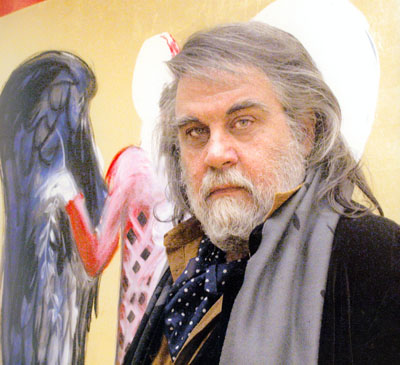
 Evangelos Odysseas Papathanassiou (Greek: Ευάγγελος Οδυσσέας Παπαθανασίου IPA:
[evˈaɲɟelos oðiˈseas papaθanaˈsiu]) (var. Papathanssiou), is a Greek composer of
electronic, new age and classical music and musical performer,
under the artist name Vangelis Papathanassiou (Βαγγέλης
Παπαθανασίου) or just Vangelis (a diminutive of
Evangelos) [IPA:
/væŋɛlɪs/ or
/vægɛlɪs/]. He is best known for his Academy Award
winning score for the film Chariots of Fire, and scores
for the films Blade Runner and 1492: Conquest of
Paradise.
Evangelos Odysseas Papathanassiou (Greek: Ευάγγελος Οδυσσέας Παπαθανασίου IPA:
[evˈaɲɟelos oðiˈseas papaθanaˈsiu]) (var. Papathanssiou), is a Greek composer of
electronic, new age and classical music and musical performer,
under the artist name Vangelis Papathanassiou (Βαγγέλης
Παπαθανασίου) or just Vangelis (a diminutive of
Evangelos) [IPA:
/væŋɛlɪs/ or
/vægɛlɪs/]. He is best known for his Academy Award
winning score for the film Chariots of Fire, and scores
for the films Blade Runner and 1492: Conquest of
Paradise.
(1943-1960) Formative years
On March 29, 1943, Vangelis (a diminutive of Evangelos) was born near Volos, Greece. He began composing at the age of four, and is largely a self-taught musician. He refused to take traditional piano lessons, and throughout his career did not have substantial knowledge of reading or writing musical notation. He studied painting, an art he also practices, at the Academy of Fine Arts in Athens.
(1961-1972) Work in bands
 In the early 1960s he was one of the
founders of pop group The Forminx (or The Formynx), which became
very popular in Greece. Based in Thessaloniki in the north of
the country, the five-piece band played a mixture of cover
versions and their own material, the latter written mostly by
Vangelis but still sung in English, something which was unusual
in Greece at that time. The Forminx released nine hit singles
and a Christmas EP before disbanding in 1966 at the peak of
their success. A film being made about them at the time was
never finished. Vangelis spent the next two years mostly
studio-bound, writing and producing for other Greek artists.
In the early 1960s he was one of the
founders of pop group The Forminx (or The Formynx), which became
very popular in Greece. Based in Thessaloniki in the north of
the country, the five-piece band played a mixture of cover
versions and their own material, the latter written mostly by
Vangelis but still sung in English, something which was unusual
in Greece at that time. The Forminx released nine hit singles
and a Christmas EP before disbanding in 1966 at the peak of
their success. A film being made about them at the time was
never finished. Vangelis spent the next two years mostly
studio-bound, writing and producing for other Greek artists.
Around the time of the student riots in 1968, Vangelis founded progressive rock band Aphrodite's Child together with Demis Roussos, Loukas Sideras and Anargyros ("Silver") Koulouris. After an unsuccessful attempt to enter the UK, they found a home in Paris, where they recorded their first single, a hit across much of Europe called Rain and Tears. Other hit singles followed, and two albums (which combined sold over 20 million copies), but when the record company demanded a third album, Vangelis conceived the ground-breaking double-album 666, based on Revelation, the last book in the Bible, and now considered pivotal in the development of progressive rock and concept albums. Tensions between members during the recording of 666 eventually caused the split of the band in 1971, but the album was still released in 1972. Despite the split, Vangelis has since produced several albums and singles for Demis Roussos, who has in turn contributed vocals to the Blade Runner soundtrack.
(1970-1972) Early solo works
Even while still in Aphrodite's Child, Vangelis had already been involved in other projects which strongly hinted at a future career as a solo musician. In 1970 he had composed the score for a little-known film called Sex Power (Demis Roussos provided some vocals). In 1971 some jam sessions with a group of musicians at Marquee Studios in London had resulted in two albums' worth of material, unofficially released without Vangelis' permission in 1978, titled Hypothesis (aka Visions of the Future), and The Dragon. Vangelis took action to have them withdrawn. A more successful project was his scoring of wildlife films made by French filmmaker Frédéric Rossif. The first was L'Apocalypse des Animaux, released in 1973 though it may have been recorded as early as 1971. In 1972, the student riots of 1968 provided the inspiration for an album titled Fais que Ton Rêve Soit Plus Long que la Nuit (Make your dream last longer than the night), comprising musical passages mixed with news snippets and protest songs - some lyrics were based on graffiti daubed on walls during the riots.
(1973-1980) Solo Career
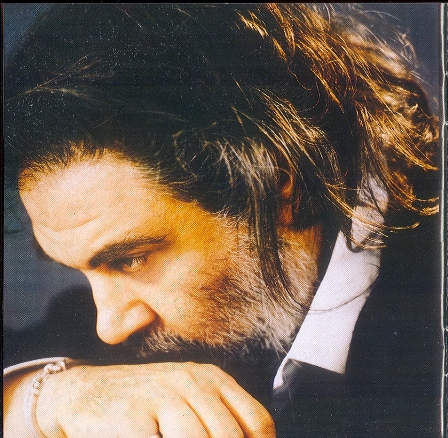 In 1973 Vangelis' solo career began in
earnest. His first "official" solo album was Earth,
though it did actually feature a group of musicians including
ex-Aphrodite's Child guitarist Silver Koulouris and also
vocalist and songwriter Robert Fitoussi (better known as F.R.
David of "Words Don't Come Easy" fame). This line-up, later
briefly going out under the name "Odyssey," released a single in
1974 titled "Who," but that was Vangelis' last involvement with
them. Later in 1974, Vangelis was widely tipped to join another
prog-rock band, Yes, following the departure of Rick Wakeman.
After a couple of weeks of rehearsals it became clear that
things were not going well and he never did join the band (they
ended up hiring Swiss keyboard player Patrick Moraz, who later
joined the Moody Blues). Vangelis did however become friends
with Yes' singer Jon Anderson, and later worked with him on many
occasions, including as the duo Jon & Vangelis.
In 1973 Vangelis' solo career began in
earnest. His first "official" solo album was Earth,
though it did actually feature a group of musicians including
ex-Aphrodite's Child guitarist Silver Koulouris and also
vocalist and songwriter Robert Fitoussi (better known as F.R.
David of "Words Don't Come Easy" fame). This line-up, later
briefly going out under the name "Odyssey," released a single in
1974 titled "Who," but that was Vangelis' last involvement with
them. Later in 1974, Vangelis was widely tipped to join another
prog-rock band, Yes, following the departure of Rick Wakeman.
After a couple of weeks of rehearsals it became clear that
things were not going well and he never did join the band (they
ended up hiring Swiss keyboard player Patrick Moraz, who later
joined the Moody Blues). Vangelis did however become friends
with Yes' singer Jon Anderson, and later worked with him on many
occasions, including as the duo Jon & Vangelis.
After moving to London, Vangelis signed with RCA Records, set up his own studio, Nemo Studios, very close to Marble Arch, and began recording a string of electronic albums, such as Heaven and Hell (1975), Albedo 0.39 (1976), Spiral (1977), Beaubourg (1978), and China (1979). Parts of Heaven and Hell were later used as the theme to the PBS television series Cosmos by Carl Sagan. A melody from Albedo 0.39 called "Alpha" was also used in Cosmos. Another part (the song "So Long Ago, So Clear"), featured guest vocals by Jon Anderson, marking the start of that successful partnership. Vangelis also contributed as a producer and keyboard player to the album Phos, which was perhaps the most important recording by Greek rock band Socrates Drank The Conium.
In 1979 Vangelis provided the score for another animal documentary by Frédéric Rossif. Called Opera Sauvage, and almost as well known as L'Apocalypse des Animaux, the resulting soundtrack would bring him to the attention of some of the world's top filmmakers. The music itself would be re-used in other films (most notably the track "L'Enfant" in The Year of Living Dangerously (1982) by Peter Weir) and television commercials (the track "Hymne", used in Barilla pasta commercials in Italy and Ernest & Julio Gallo wine ads in the US).
(1981-1999) Film Work
Chariots of Fire
In 1981 Vangelis wrote the score for the film Chariots of Fire, set at the Paris Olympics in 1924. Though the electronic score might be considered, in hindsight, ill-suited to a period piece, it worked. The movie won a half-dozen awards, including an Academy award for Best Picture of the year. Vangelis won the Academy Award for Original Music Score. The opening theme of the film was released as a single in 1982, topping the American Billboard chart for one week after climbing steadily for five months. Only one other instrumental track, 1985's "Miami Vice Theme," by Czech musician Jan Hammer, has topped that chart since.
Greek musician Stavros Logarides claimed Vangelis had copied the melody of "Titles" from one of his compositions called "City of Violets". Once a member of a 1970s band called Poll and actually a friend of Vangelis at that time, Logarides sued Vangelis for plagiarism in 1987. When the case came to court, Vangelis set up synthesizers in the courtroom and played for the judge and all others present, though less for entertainment purposes and more so he could demonstrate his compositional process. The judge ruled that "Titles" was a Vangelis original, being a strong, vibrant piece of music, whereas "City of Violets" was fairly sombre and somewhat mournful by comparison, and any similarities in the melody were minor.
In February 1981, Vangelis, together with Jon Anderson, adapted the main theme from Chariots of Fire with lyrics for his friend Demis Roussos. It was recorded at Vangelis' London Nemo Studios and released as a single,"Race to the End", in March 1981.
Other notable Vangelis soundtracks were Antarctica for Nankyoku Monogatari in 1983, and The Bounty in 1984. Vangelis also collaborated in 1981 and 1986 with Italian singer Milva, achieving a large success especially in Germany with the albums Ich Hab' Keine Angst and Geheimnisse. (I am fearless and Secrets) The Italian language Nana Mouskouri Album also featured her singing his composition Ti Amero. Collaboration numbers with lyricist Mikalis Bourboulis sung by Maria Farantouri included the tracks Odi A, San Elektra, and Tora Xero.
Blade Runner
In 1982, Vangelis began a collaboration with director Ridley Scott, writing the score for the science fiction film Blade Runner (1982). Capturing the isolation and melancholy of Harrison Ford's Rick Deckard character, the Vangelis score is as much a part of the dystopian environment as the decaying buildings and ever-present rain.
Unfortunately, a disagreement led to Vangelis withholding permission for his performance of the music from Blade Runner to be released, and the studio instead hired a group of musicians dubbed "The New American Orchestra" to record the official LP released at the time. It would take 12 years before things could be worked out and Vangelis' own work be released in the United States in 1994. Yet this soundtrack was still incomplete, as the film contained some non-Vangelis tracks as well. Over the years a series of bootleg recordings of Blade Runner soundtrack from unknown sources have been released, mostly targeted to collectors as "private releases," that contain most of the music cues (including the Ladd Company logo theme). A 3 disc boxset has been released in late 2007 containing the 1994 album, a second disc containing some more of the missing music cues and a third disc of new Vangelis material inspired by Blade Runner. Unfortunately, the 2007 release is still missing some incidental music, most notably the background music from the Taffey Lewis bar scene featuring vocals by Demis Roussos.
1492: Conquest of Paradise
In 1992, Paramount Pictures released the film 1492: Conquest of Paradise, also directed by Ridley Scott, as a 500th anniversary commemoration of Christopher Columbus' voyage to the New World.
Vangelis's score was nominated as "Best Original Score - Motion Picture" at the 1993 Golden Globe awards, but was not nominated for an Academy Award.
Other Works
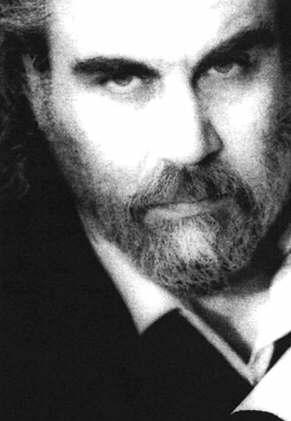 Vangelis also scored a number of
undersea documentaries by Jacques-Yves Cousteau. In 1992, France
made him a Knight of the Order of Arts and Letters.
Vangelis also scored a number of
undersea documentaries by Jacques-Yves Cousteau. In 1992, France
made him a Knight of the Order of Arts and Letters.
In 1983 Vangelis wrote the music for Michael Cacoyannis' staging of the Greek tragedy Elektra which was performed featuring Irene Papas at the open-air amphitheater at Epidavros in Greece. The same year Vangelis composed his first score for a ballet by Wayne Eagling. It was originally performed by Lesley Colier and Wayne Eagling himself at an Amnesty International gala in Drury Lane, but in 1984 the Royal Ballet School presented it again at the Sadler's Wells theater. In 1985 and 1986, Vangelis wrote two more ballets: "Frankenstein - Modern Prometheus" and "The Beauty and the Beast". In 1992, Vangelis composed music for the intense dramatic performance "Medea" by Euripides, starring Irene Papas, Carlos Lucena, Manuel de Blas, Jordi Dauder and Miquel Cors. Director Nuria Espert is considered to be one of the best theater actresses and directors in Spain. The play was staged in Barcelona during July 1992 and was produced by the Olympic Festival of Arts. The sound design was by Denis Vanzetto who also worked various Vangelis albums.
During the 1980s and 1990s, Vangelis and Jon Anderson released four albums together as Jon & Vangelis.
The Olympic Games
In May 2000, Vangelis composed the music as well as designed and directed the artistic Olympic flag relay portion of the Closing Ceremonies of the 2000 Sydney Olympic Games. The performance prompted many, including Vangelis himself, to think that he would play an influential role in the artistic development of the 2004 Athens Olympic Games. The Athens Olympic Committee (ATHOC) had other plans, however, and perhaps to the dismay of much of the Greek populace, the job was given to someone else. Speculation suggests that internal politics won the day and Olympic planners simply wanted a more contemporary, less Greek image for the Games. STATUS magazine author Nikos Mouratidis interviewed Vangelis in June 2002 and concluded the following:
Since Vangelis is so familiar with Greek mythology, he should know that Greece is just like Saturn, who ate his children. And Greece prefers to eat Vangelis who is its child rather than all those who have little to do with Greece, tradition, culture and its dreams.
While no official recording of Vangelis' composition for the 2000 Sydney Games exists, the music can be heard accompanying the presentation of the emblem of the 2004 Athens Games.
(2000-present)
In 2001, Vangelis performed live and released Mythodea, a predominantly orchestral rather than electronic piece that was originally written in 1993, and used by NASA as the theme for the Mars Odyssey mission.
In 2001 Vangelis once more composed music for Irene Papas' play - "Las Troyanas". In 2002 he wrote music for staging of Shakespeare's "The Tempest" to open the new Hungarian National Theater.
In 2004, Vangelis released the score for Oliver Stone's Alexander, continuing his involvement with projects related to his homeland.
In 2007, Vangelis released 2 albums. First was a 3CD set for the 25th Anniversary of Blade Runner, titled Blade Runner Trilogy. Second is the soundtrack for the Greek movie, El Greco, titled El Greco Original Motion Picture Soundtrack.
Vangelis' website, "Vangelis Information World", went online in 1996 with an announcement of Oceanic but since then it has been under construction.
The "Direct" Technique
Vangelis uses a technique of recording all tracks simultaneously on tape, using a device especially manufactured for him which he calls the "Direct box".
-
"He explains his customary method of approach. As soon as the musical idea is there, as many keyboards as possible are connected to the control-desk, which in turn are directly connected to the applicable tracks of the multi-trackmachine. The idea now is to play as many keyboards as possible at the same time. That way as broad a basis as possible develops which only needs fine-tuning. After that it’s a question of adding things or leaving out things."