
 Kitaro was born in February
4, 1953 as "Masanori Takahashi" in Toyohashi, Aichi Prefecture, Japan, as the
son of shintoistic farmers. His pseudonym "Kitaro" was given later by friends
because of a Japanese television cartoon character, "Kitaro".
Kitaro was born in February
4, 1953 as "Masanori Takahashi" in Toyohashi, Aichi Prefecture, Japan, as the
son of shintoistic farmers. His pseudonym "Kitaro" was given later by friends
because of a Japanese television cartoon character, "Kitaro".
Inspired by the R&B music of
Otis Redding, Kitaro taught himself how to play guitar. He says of teaching
himself, "I never had education in music, I just learned to trust my ears and my
feelings." He gives credit for his creations to a power beyond himself. "This
music is not from my mind," he said. "It is from heaven, going through my body
and out my fingers through composing. Sometimes I wonder. I never practice. I
don't read or write music, but my fingers move. I wonder 'Whose song is this?' I
write my songs, but they are not my songs."
While attending Toyohashi Commercial High School, he organized the "Albatross"
band with his friends. At that time, they performed in parties and clubs. "In
high school, I was in an amateur band. I started out playing the guitar but then
changed to the keyboards. Before one of our gigs, the drummer was injured. I had
no experience at all on the drums, but I had to learn it because I was the
leader of the band, and we had to do the gig. My drumming was not very good, but
we got through the show in one piece. Later, the bassist had injuries, so I had
to learn how to play the bass. [These accidents are] the main reasons why I can
play all these instruments; I had a crash course in how to play them. It was a
hard time for me, but a very good experience. It created the base knowledge of
all the instruments I use and need to create my current brand of music. After
graduating, I really wanted to be in the music business, so I moved to Tokyo and
started looking for bands to play with. I basically did it for the experience
and to get a feel of all the clubs that were available in Tokyo and Yokohama. At
that time I played keyboards, and then I discovered the synthesizer. This was a
revelation. First of all, the instructions for the thing were in English so I
couldn't read them. I was trying to make sounds but couldn't! I tried for a
whole day, but no sound ever came out because I didn't know how to program it or
set it up. Finally, the first sound I got off this thing was a wind-like sound,
but I was so elated that I actually made some noise, it didn't matter. I turned
one of the knobs slowly to make more wind-like noises. Then I decided to buy
another synthesizer to form a different type of sound. I just loved the analog
sound that it made compared to today's digital sound. Now, my equipment and
synthesizers are all analog. But technically, digital is much easier to use for
editing and other stuff."
His parents were first opposed to the idea of their son having a musical career.
They had other plans for him and in an attempt to get him to see their way, made
arrangements for him to take a job at a local company. However he left home
without telling them before. He supported himself by taking on several part time
jobs such as cooking and civil service work while composing songs at night.
 In the early '70s he changed completely to keyboards. He joined the band "Far
East Family Band" and toured with them around the world. In Europe he met the
German synthesizer musician and former Tangerine Dream member Klaus Schulze.
Schulze produced two albums for the band and gave Kitaro some tips for the use
of synthesizers.
In the early '70s he changed completely to keyboards. He joined the band "Far
East Family Band" and toured with them around the world. In Europe he met the
German synthesizer musician and former Tangerine Dream member Klaus Schulze.
Schulze produced two albums for the band and gave Kitaro some tips for the use
of synthesizers.
In 1976 he left the band and travelled through Asia (China, Laos, Thailand,
India).
Back in Japan Kitaro started
his solo career in 1977. The first two albums ''Ten Kai'' and ''From the Full
Moon Story'' became cult favorites of fans of the nascent New Age movement. He
performed his first symphonic concert at the 'Small Hall' of the Kosei Nemkin
Kaikan in Shinjuku, Toyko. During this concert Kitaro used a synthesizer to
recreate the sounds of 40 different instruments, a world's first. But it was his
famous soundtrack for the NHK series "Silk Road" which brought him the
international attention.
He struck a worldwide distribution arrangement with Geffen Records in 1986; in
1987 he collaborated with different musicians, e.g. with Micky Hart (Grateful
Dead) and Jon Anderson (Yes) and his record sales soared to 10 million
worldwide. He was then nominated twice for a Grammy and his soundtrack (for the
movie "Heaven & Earth") won a 1994 award for best original score. His biggest
musical success was the Grammy Award 2001 for his album ''Thinking of You''.
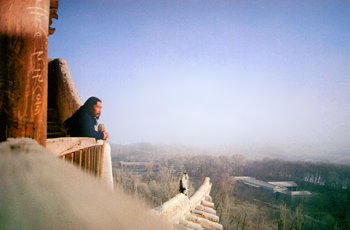 Kitaro is a star, but he is
very modest. "Nature inspires me. I am only a messenger", he said. "To me, some
songs are like clouds, some are like water". Since 1983 his reverence for nature
leads Kitaro to annually give thanks to Mother Nature in a special "concert" on
Mount Fuji or near his house in Colorado. On the day of the full moon of August
he beats on the Taiko drum from dusk to dawn. Frequently his hands become
bloodied, but he continues to pound.
Kitaro is a star, but he is
very modest. "Nature inspires me. I am only a messenger", he said. "To me, some
songs are like clouds, some are like water". Since 1983 his reverence for nature
leads Kitaro to annually give thanks to Mother Nature in a special "concert" on
Mount Fuji or near his house in Colorado. On the day of the full moon of August
he beats on the Taiko drum from dusk to dawn. Frequently his hands become
bloodied, but he continues to pound.
Discography:
Best Collection
Daylight, Moonlight: Live in Yakushiji

Far East Family Band
Greatest Hits
Kitaro World Vol. 01 - Silkroad Legend
Kitaro World Vol. 02 - Silent Praying
Kitaro World Vol. 03 - Faraway Land
Kitaro World Vol. 04 - Eternal Trip
Kitaro World Vol. 05 - Holy Vibration
Kitaro World Vol. 06 - Breezing Universe
Kitaro World Vol. 07 - Fairy Stories
Kitaro World Vol. 08 - Divine Spirits
Kitaro World Vol. 09 - Galactic Flight
Kitaro World Vol. 10 - Heart Beat
Kitaro's World of Music Featuring Nawang
Khechog
Kitaro's World of Music Featuring Yu-Xiao Guang
Meets the London Symphony Orchestra
My Best [Celestial]
Queen Millennia [Original Soundtrack]
Sacred Journey of Ku-Kai, Vol. 2
Silk Road Suite, Vol. 1
Silk Road Suite, Vol. 2
Silk Road, Vols. 1 & 2
The Best of Ten Years (1976-1986)
The Essential Collection I
The Essential Collection III
Twin Best
Karavansary - Kitaro
Orochi - kitaro
Matsuri - Kitaro
Howling Thunder - Kitaro
|
Design & Developed By J. Díaz -
Frogmen
If any text, images or other material here are in some form of violation of copyright infringement
please forward the author,
Thanks.
|
